

Stop Solving Problems That Keep Coming Back
How to Turn Operational Chaos Into Your Biggest Moat

Let me describe a scene you’ll probably recognize.
You’re six months into your PM role at a company undergoing a “digital transformation” and with “operational complexity.” Maybe it’s logistics, healthcare, financial services, government, or PropTech. You’ve shipped three features. Each one solved a real problem. Stakeholders are happy. Your sprint velocity looks great.
And yet... something feels off.
The same complaints keep surfacing in different forms. The integration work never ends. Every new feature requires touching five systems. Your “quick wins” are starting to feel like whack-a-mole.
Here’s the uncomfortable truth: you’re not solving problems—you’re treating symptoms.
I spent 20 years learning this lesson the hard way. I built countless point solutions. I celebrated the shipped features. And I watched organizations slowly drown in the complexity of their own “solutions.”
Eventually, I figured out a different approach. I call it the Complexity-to-Product Transformation Model (C2P) ©. It’s not another framework to hang on your wall. It’s a systematic way to see the hidden patterns in operational chaos—and turn them into your biggest competitive advantage. So, if you are a Product Manager or a Digital Transformation Leader or whatever designation attached to you but tasked with transforming the organization from its operational chaos, this is an end-to-end framework for you.
The Point Solution Trap
Before we get into the model, let’s talk about why smart PMs keep falling into the same trap.
In operationally complex organizations, there’s always a backlog full of urgent problems. Stakeholders have real pain. The pressure to ship is intense. So you do what good PMs do: you prioritize, you build, you deliver.
The problem? Each solution creates its own gravity. It needs maintenance. It needs integration. It needs documentation, training, and support. And because it solved that specific problem for that specific team, it didn’t help the three other teams with similar-but-not-identical problems.
Fast forward two years. You’ve got 47 point solutions. Seven of them overlap. Four are abandoned. The integration layer looks like spaghetti. And the original problems? Still there—they just wear different masks now.
I call this “solution sprawl,” and it’s the silent killer of digital transformation.
The Insight That Changed Everything
The breakthrough came when I stopped looking at problems and started looking at patterns.
At Amazon in our custom & collectibles product marketplace, we had 47 documented pains across seller onboarding, catalog management, and marketplace operations. Forty-seven. That’s a lot of backlog items.
But when we traced each pain to its root cause—really traced it, not just one level deep—we discovered something remarkable: 31 of those 47 pains (66%) shared a single root cause. No unified catalog architecture across marketplaces for easy listing of custom products.
We weren’t looking at 47 problems. We were looking at one problem wearing 31 different costumes.
This is the core insight of the C2P Model:
Pains that cluster share root causes.
Address the root cause, and you solve the cluster.
This isn’t just efficient—it’s transformational. Because once you solve for root causes, you’re not building point solutions anymore. You’re building capabilities. And capabilities compound.
The Four Phases of C2P Model
The Complexity-to-Platform Transformation Model has four phases. Each builds on the last. Skip one, and the whole thing falls apart.
Phase 1: DECOMPOSE — Map the Chaos
Before you can find patterns, you need data. Lots of it.
Most PMs stop at 10-15 pain points. That’s not enough. In complex organizations, you need 50-200 documented pains to see the real patterns emerge. This feels excessive until you realize you’re not building a backlog—you’re building a diagnostic dataset.
How to do it: Interview everyone - folks running shadow operations, shadow IT teams developing their own solutions. Read every support ticket. Attend cross-functional meetings. Listen for the signal phrases & classify them into one of the four buckets.
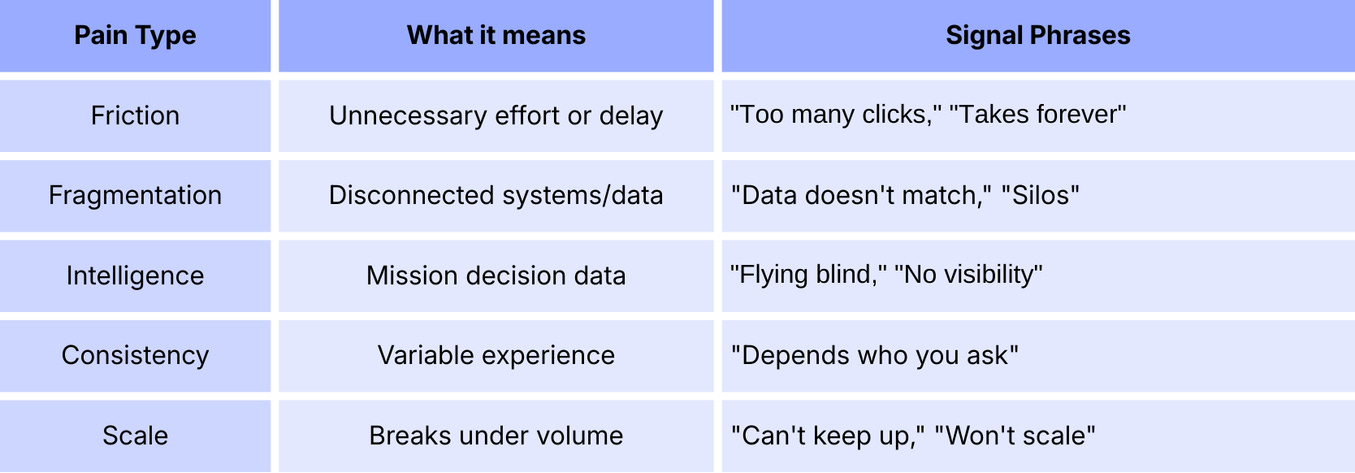
Pro tip: Don’t filter or prioritize yet. That’s the trap. Capture everything. The patterns won’t emerge until you have enough data points.
Phase 2: CORRELATE — Find the Clusters
This is where the magic happens. Take your pain inventory and start asking “why” for each one. Not once—five times. The “5 Whys” technique sounds simple, but it’s brutally effective at exposing root causes hiding behind symptoms.
Example:
Pain: “Sellers complain about inconsistent product listings across marketplaces”
Why? Different teams manage different marketplaces
Why? Each marketplace has its own catalog system
Why? We built marketplace-specific solutions over time
Why? No unified catalog architecture exists
Root cause: Missing unified product identity layer
Now do this for every high-impact pain. You’ll start seeing clusters form—multiple pains tracing back to the same root cause.
Score each cluster using this formula:
C2P Score = (Pain Density × 0.3) + (Impact Magnitude × 0.5) + (Solvability × 0.2)The highest-scoring clusters are your platform candidates. These are the root causes worth building capabilities around.
Phase 3: ARCHITECT — Design Capabilities, Not Features
Here’s where most product-led transformations go wrong: they jump straight from problems to products.
The C2P Model inserts a crucial layer in between: platform capabilities.
A capability is a reusable service that addresses a root cause. A product is a user-facing solution that consumes capabilities to solve specific pains.
This distinction matters enormously:
Capabilities are stable, reusable, and consumed through APIs
Products are focused, user-facing, and rapidly evolving
When you mix these concerns—when a platform tries to solve problems directly—it becomes bloated. When a product tries to be a platform, it becomes unfocused.
The Separation Test: Before calling something a “platform capability,” ask these five questions:
Could 2+ products consume this independently?
Is it stable (changes less than annually)?
Can you define a clear API contract?
Would it reduce, not add, overall complexity?
Does single-team ownership clarity exist?
5/5 = Strong platform capability. ≤3/5 = Probably a product feature. Don’t force it.
Phase 4: ACTIVATE — Ship Products, Not Platforms
Here’s the counterintuitive part: you don’t ship platforms. You ship products.
Platforms are invisible infrastructure. Products are what users see, touch, and love (or hate). Your job in Phase 4 is to build focused products that consume platform capabilities to solve specific pain clusters.
Before building any feature, run it through the Bloat Detector:
Does this address a documented pain from our inventory?
Does it consume (not duplicate) an existing capability?
Can we deliver this without new integration points?
Will this remain relevant in 2 years?
Does one persona clearly own this?
Can we measure success with existing metrics?
6 Yes = Build it. 4-5 = Proceed with caution. ≤3 = Stop. You’re about to create bloat.
Four Traps to Avoid
I’ve also seen the C2P approach fail. Usually, it’s one of these:
1. Platform Theater
Calling something a “platform” without building true capabilities. Usually a monolith with an API bolted on. If one team owns everything, it’s not a platform.
2. Boiling the Ocean
Trying to platform everything at once. If your roadmap extends beyond 18 months before first value, you’re boiling the ocean. Start with the highest-scoring cluster. Ship a product. Learn. Expand.
3. The God Product
One product that tries to solve every pain. Feature count grows faster than adoption. Onboarding takes weeks. Focused products beat feature-stuffed monsters every time.
4. Platform Island
A platform that requires “rip and replace” instead of incremental adoption. Change management becomes impossible. Great platforms coexist with legacy systems—they don’t demand wholesale replacement.
How to Start Tomorrow
You don’t need executive buy-in to start. You don’t need a transformation budget. You just need to change how you look at problems.
Week 1: Start your pain inventory. Create a spreadsheet. Every time you hear a complaint, see a workaround, or notice friction—write it down. Aim for 50 pains minimum.
Week 2-3: Run the 5 Whys. Take your top 20 pains by severity. Trace each to its root cause. Look for clusters.
Week 4: Map your first cluster. Pick the cluster with the highest correlation score. Document which pains it contains, what the root cause is, and what a capability addressing it might look like.
Then: Make the case. Show leadership you’ve traced 15 backlog items to one root cause. Propose building a capability instead of 15 features. The math speaks for itself.
The Bigger Picture
Here’s what I’ve learned after two decades of this work:
Operational complexity isn’t a bug—it’s a feature. It’s a moat. Your competitors have it too, and most of them are drowning in point solutions just like you were. The organizations that win aren’t the ones that eliminate complexity. They’re the ones that convert complexity into capability. They find the patterns others miss. They build platforms where others build features. They compound where others sprawl.
That’s the promise of product-led transformation in complex organizations. Not simplicity—leverage.
Stop solving the same problems over and over. Start building platforms that make those problems impossible.
That’s the C2P way.